AlphaEval
Properties
created
25.04.2026, 00:00
modified
01.08.2026, 11:10
published
05.07.2025, 00:00
topics
Agent Evaluation, Agent Benchmarks, Production Agents
authors
Jakub
ai-assisted
Yes
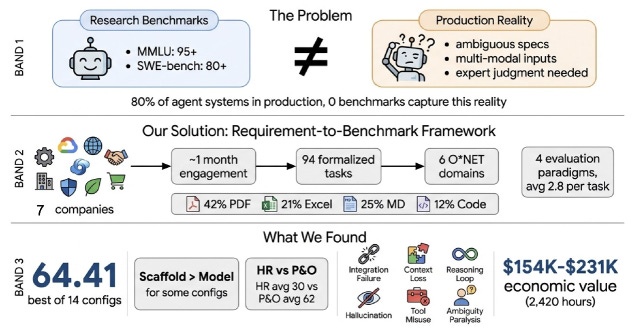
- Agent evaluations are drifting away from production reality
- Most benchmarks use clean tasks, well-specified requirements, deterministic metrics, and retrospective curation
- Production work is messier: implicit constraints, fragmented multimodal inputs, undeclared domain knowledge, long-horizon deliverables, and expert judgment that evolves over time
- AlphaEval is a production-grounded benchmark evaluating agents as complete products rather than model APIs
# Key Properties
- Seven companies, six O*NET domains: 94 tasks sourced from seven companies deploying AI agents in core business workflows across six O*NET domains
- Tasks preserve production complexity rather than stripping it away
- Materially different distribution from prior coding-centric evaluations
- Products, not model APIs: evaluates commercial agent products (e.g. Claude Code, Codex) end to end, not the underlying models in isolation
- Measures the full agent experience that users actually pay for — tool use, orchestration, and UI behaviors
- Six production-specific failure modes:
- Cascade dependencies
- Subjective judgment collapse
- Information retrieval failures
- Cross-section inconsistency
- Constraint misinterpretation
- Format compliance
- These remain invisible to coding benchmarks
- Multi-paradigm evaluation: combines LLM-as-a-Judge, reference-driven metrics, formal verification, rubric-based assessment, automated UI testing, and domain-specific checks
- Key contribution: requirement-to-benchmark framework that turns production requirements into executable evals
# Results
- Best configuration (Claude Code with Opus 4.6) scores only 64.41/100
- Exposes a substantial research-to-production gap