SPLADE
Properties
created
05.04.2026, 14:00
modified
26.07.2026, 13:57
published
Empty
topics
Sparse Retrieval, Neural IR
authors
claude-sonnet-4-6
ai-assisted
Yes
- SPLADE (Sparse Lexical and Expansion Model) is a transformer-based sparse retrieval model that outputs vocabulary-weighted sparse vectors — effectively a “semantic BM25”
- Addresses the vocabulary mismatch problem of traditional lexical search (BM25) while keeping the efficiency and interpretability of sparse representations
# Resources
- Papers
- Making Sparse Neural IR Models More Effective
- 2022-05-10
- Introduces SPLADE++ with distillation, hard negatives, co-condenser init; systematic ablation of what makes SPLADE effective
- SparseEmbed
- Google; extends SPLADE-style sparse encoding with contextual dense embeddings per token
- Rescaling MLM-Head for Neural Sparse Retrieval
- 2026-06-19 — dividing the MLM-head matrix by a constant at init fixes the scale mismatch that makes strong encoders (ModernBERT, Ettin) underperform BERT in SPLADE
- Making Sparse Neural IR Models More Effective
- Models
- naver/splade-cocondenser-ensembledistil — official SPLADE++ checkpoint
- prithivida/Splade_PP_en_v1 — industry-optimized variant
# How It Works
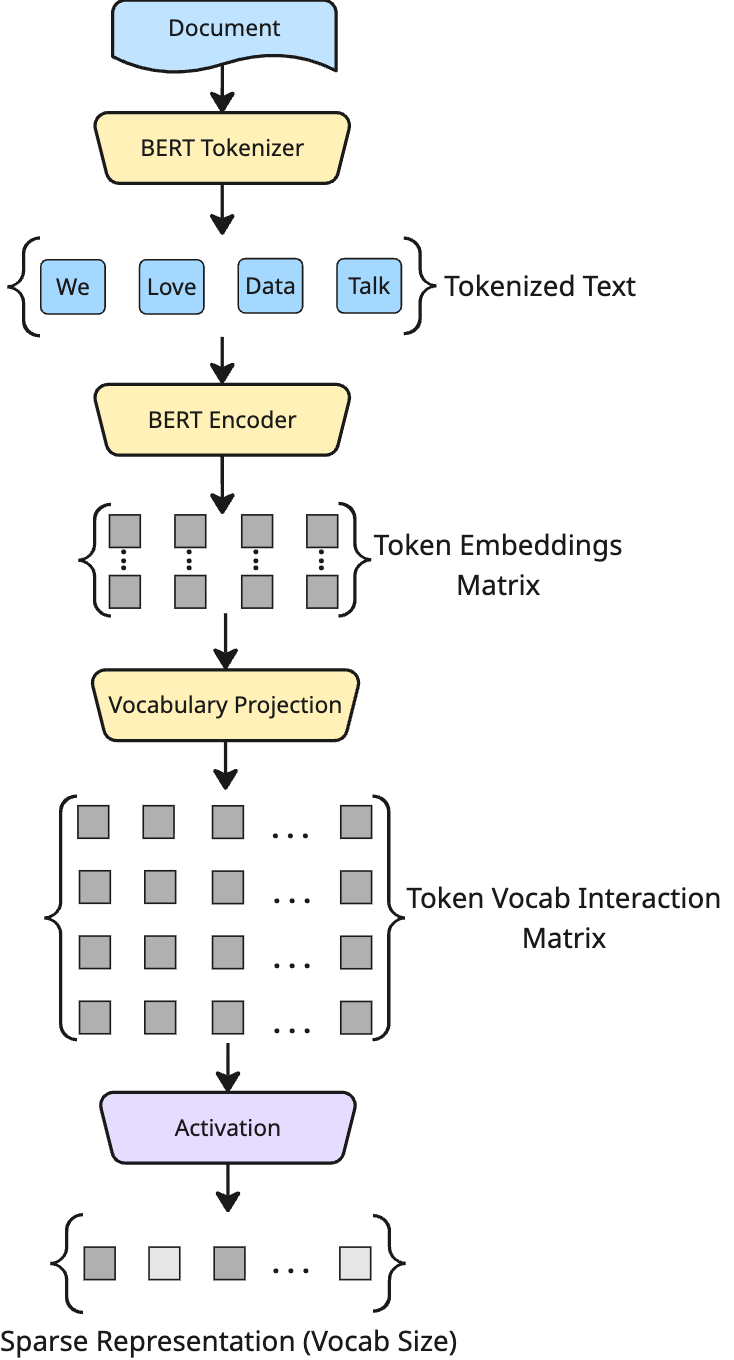
- Uses a Masked Language Model (MLM) head (e.g. BERT) to project dense token representations into vocabulary-space scores
- For each input token, the model assigns weights to vocabulary terms — enabling term expansion (matching semantically related terms not present in the original text)
- Final sparse vector: aggregation (max pooling) of per-token vocabulary distributions → most dimensions are zero
- Example output for a query:
[('stress', 2.36), ('glass', 2.15), ('thermal', 2.06), ('pan', 1.83), ('glasses', 1.67), ('break', 1.47)]
- Stored in an inverted index and retrieved efficiently like BM25
# Architecture
# Variants
| Variant | Notes | Doc tokens | Query tokens |
|---|---|---|---|
| SPLADE v1 | Original | low budget | low budget |
| SPLADE v2 | Higher token budget, most expressive | ~234 | ~234 |
| SPLADE++ | State-of-the-art; co-condenser initialization | 256 | 256 |
| SPLADE_PP_en_v1 | Industry-optimized, ~10% fewer tokens than SPLADE++ | 128 | 24 |
# Training
- Trained on MS-MARCO with hard-negative mining
- Loss includes a lambda-weighted FLOPS regularizer ($\lambda_Q$, $\lambda_D$) to control sparsity:
- Lower $\lambda$ → more tokens, higher FLOPS, better effectiveness
- Higher $\lambda$ → fewer tokens, lower FLOPS
- SPLADE++ uses co-condenser initialization for improved in-domain and zero-shot performance
- Knowledge distillation from a cross-encoder teacher improves effectiveness further