Autoencoders
Properties
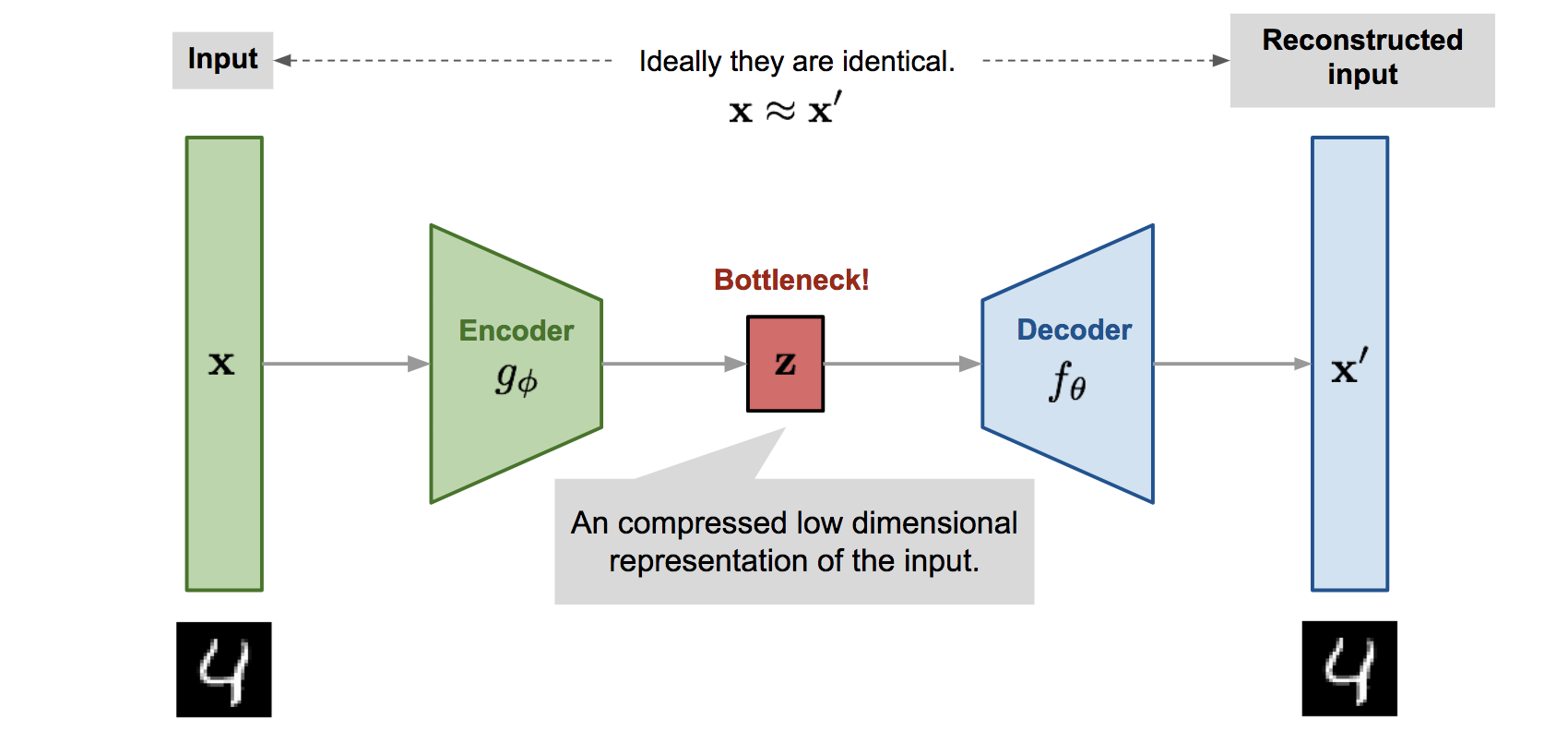
Autoencoders are a special kind of neural network used to perform dimensionality reduction. We can think of autoencoders as complex systems composed of two networks, an encoder \(g\) and a decoder \(f\).
The encoder learns a non-linear transformation \(g:X \to Z\) that projects the data from the original high-dimensional input space \(X\) to a lower-dimensional latent space \(Z\). We call \(z = g(x)\) a latent vector. A latent vector is a low-dimensional representation of a data point that contains information about \(x\). The transformation \(g\) should have certain properties; for instance, similar values of \(x\) should have similar latent vectors and dissimilar values of \(x\) should likewise have dissimilar latent vectors.
A decoder learns a non-linear transformation \(f: Z \to X\) that projects the latent vectors back into the original high-dimensional input space \(X\). This transformation should take the latent vector \(z = g(x)\) and reconstruct the original input data \(\hat{x} = f(z) = f(g(x))\).
An autoencoder is just the composition of the encoder and the decoder \(F(x) = f(g(x))\). The autoencoder is trained to minimize the difference between the input \(x\) and the reconstruction \({x'}\) using a kind of reconstruction loss. Because the autoencoder is trained as a whole (we say it’s trained “end-to-end”), we optimize the encoder and the decoder simultaneously.