Flash Attention
Properties
Scaling the transformer architecture is heavily bottlenecked by the self-attention mechanism, which has quadratic time and memory complexity. Recent developments in accelerator hardware mainly focus on enhancing compute capacities and not memory and transferring data between hardware. This results in attention operation having a memory bottleneck. Flash Attention is an attention algorithm used to reduce this problem and scale transformer-based models more efficiently, enabling faster training and inference.
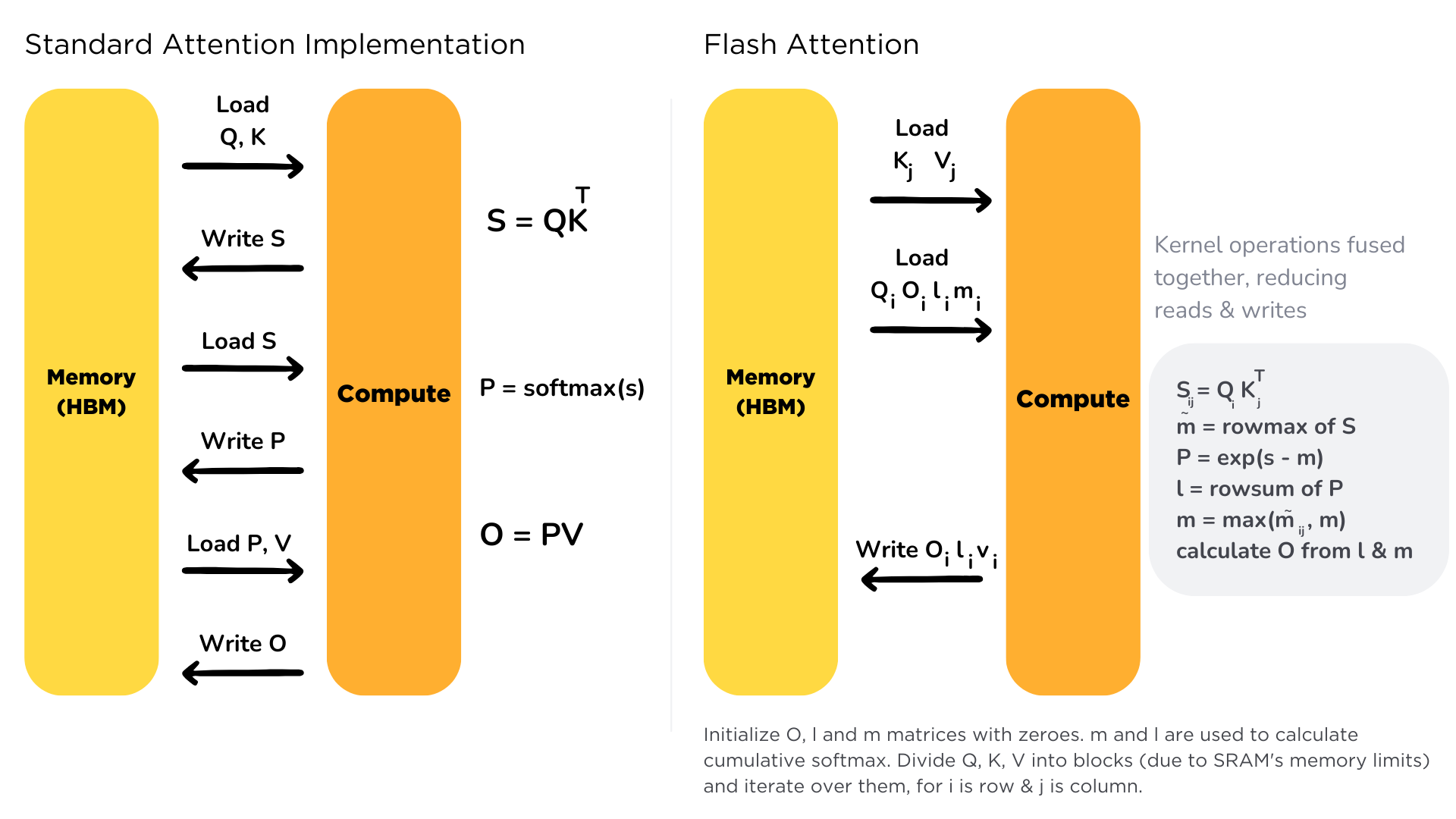
Standard attention mechanism uses High Bandwidth Memory (HBM) to store, read and write keys, queries and values. HBM is large in memory, but slow in processing, meanwhile SRAM1 is smaller in memory, but faster in operations. In the standard attention implementation, the cost of loading and writing keys, queries, and values from HBM is high. It loads keys, queries, and values from HBM to GPU on-chip SRAM, performs a single step of the attention mechanism, writes it back to HBM, and repeats this for every single attention step. Instead, Flash Attention loads keys, queries, and values once, fuses the operations of the attention mechanism, and writes them back.
 ## Original Paper
[FlashAttention: Fast and Memory-Efficient Exact Attention with IO-Awareness](https://arxiv.org/abs/2205.14135):
> FlashAttention, an IO-aware exact attention algorithm that uses tiling to reduce the number of memory reads/writes between GPU high bandwidth memory (HBM) and GPU on-chip SRAM. We analyze the IO complexity of FlashAttention, showing that it requires fewer HBM accesses than standard attention, and is optimal for a range of SRAM sizes. We also extend FlashAttention to block-sparse attention, yielding an approximate attention algorithm that is faster than any existing approximate attention method.
## Original Paper
[FlashAttention: Fast and Memory-Efficient Exact Attention with IO-Awareness](https://arxiv.org/abs/2205.14135):
> FlashAttention, an IO-aware exact attention algorithm that uses tiling to reduce the number of memory reads/writes between GPU high bandwidth memory (HBM) and GPU on-chip SRAM. We analyze the IO complexity of FlashAttention, showing that it requires fewer HBM accesses than standard attention, and is optimal for a range of SRAM sizes. We also extend FlashAttention to block-sparse attention, yielding an approximate attention algorithm that is faster than any existing approximate attention method.Static random-access memory ↩︎