G-Eval
Properties
created
02.02.2026, 20:54
modified
21.02.2026, 10:19
published
Empty
sources
G-Eval Simply Explained: LLM-as-a-Judge for LLM Evaluation · G-EVAL: NLG Evaluation using GPT-4 with Better Human Alignment
topics
Evaluation, LLM-as-a-Judge, G-Eval
authors
Empty
ai-assisted
No
- G-Eval is a SOTA, research-backed framework that uses LLM-as-a-judge to evaluate LLM outputs on any criteria using everyday language.
- G-Eval uses various techniques such as chain-of-thought, token weight summation, and form-filling paradigms to bypass pitfalls LLM judges are commonly vulnerable to.
- G-Eval can be further optimized by introducing rubrics, hardcoding criteria, and extended to a multi-turn use case.
- G-Eval can be used to evaluate AI agents, for both single-turn and multi-turn use cases.
- DeepEval allows anyone to implement G-Eval in under 5 lines of code ( docs here).
# What is G-Eval?
G-Eval is a framework that uses LLM-as-a-judge with chain-of-thoughts (CoT) to evaluate LLM outputs based on ANY custom criteria. It leverages an automatic chain-of-thought (CoT) approach to decompose your criteria and evaluate LLM outputs through a three-step process:
- Evaluation Step Generation: an LLM first transforms your natural language criterion into a structured list of evaluation steps.
- Judging: these steps are then used by an LLM judge to assess your application’s output.
- Scoring: the resulting judgments are weighted by their log-probabilities to produce a final G-Eval score.
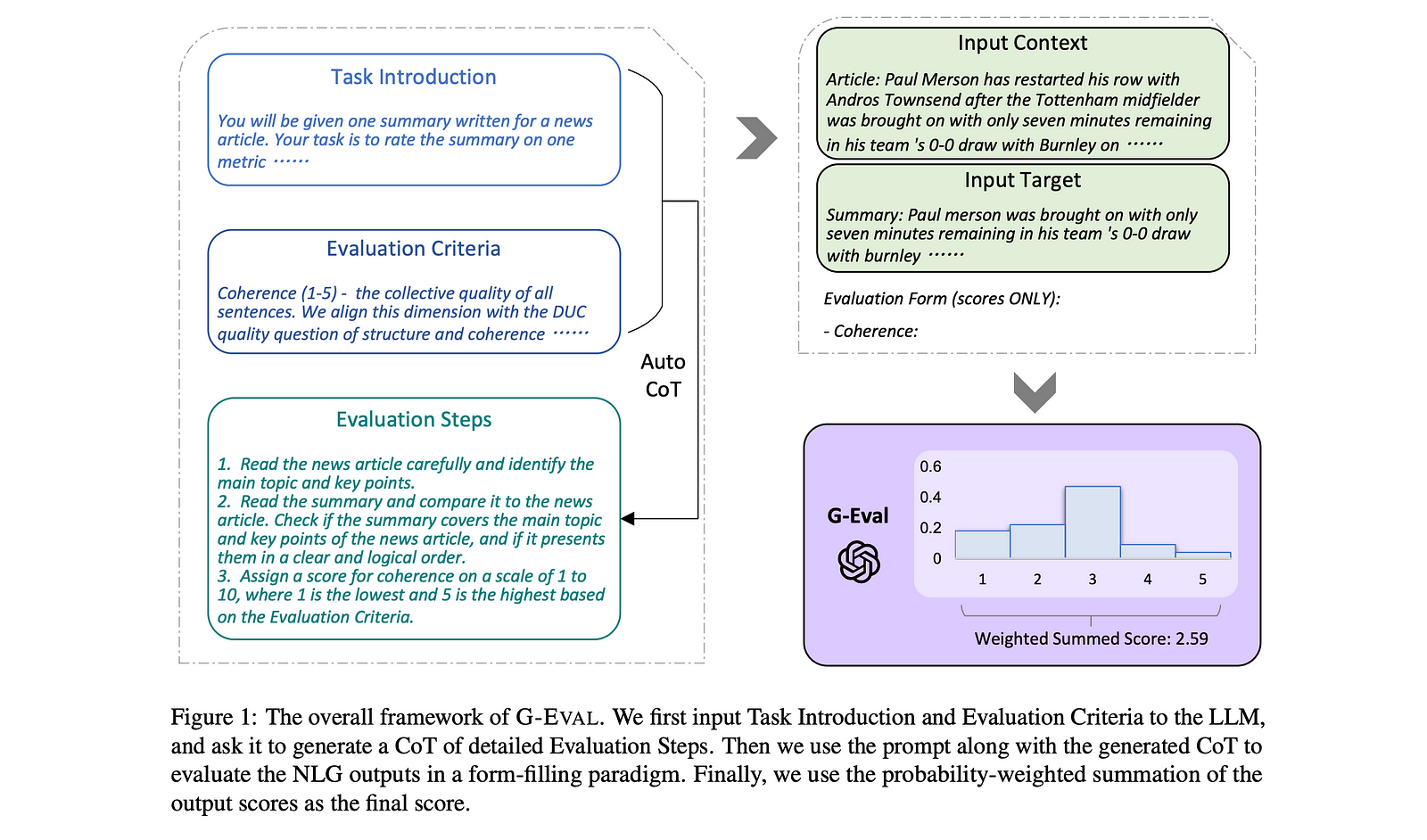
G-Eval was first introduced in the paper “NLG Evaluation using GPT-4 with Better Human Alignment”, and was originally developed as a superior alternative to traditional reference-based metrics like BLEU and ROUGE, which struggles with subjective and open-ended tasks that requires creativity, nuance, and an understanding of word semantics.