Late Chunking
Properties
tags
gen_aigen_ai/rag
created
07.02.2025, 16:43
modified
02.08.2026, 10:19
published
Empty
topics
Chunking
authors
Jakub
ai-assisted
No
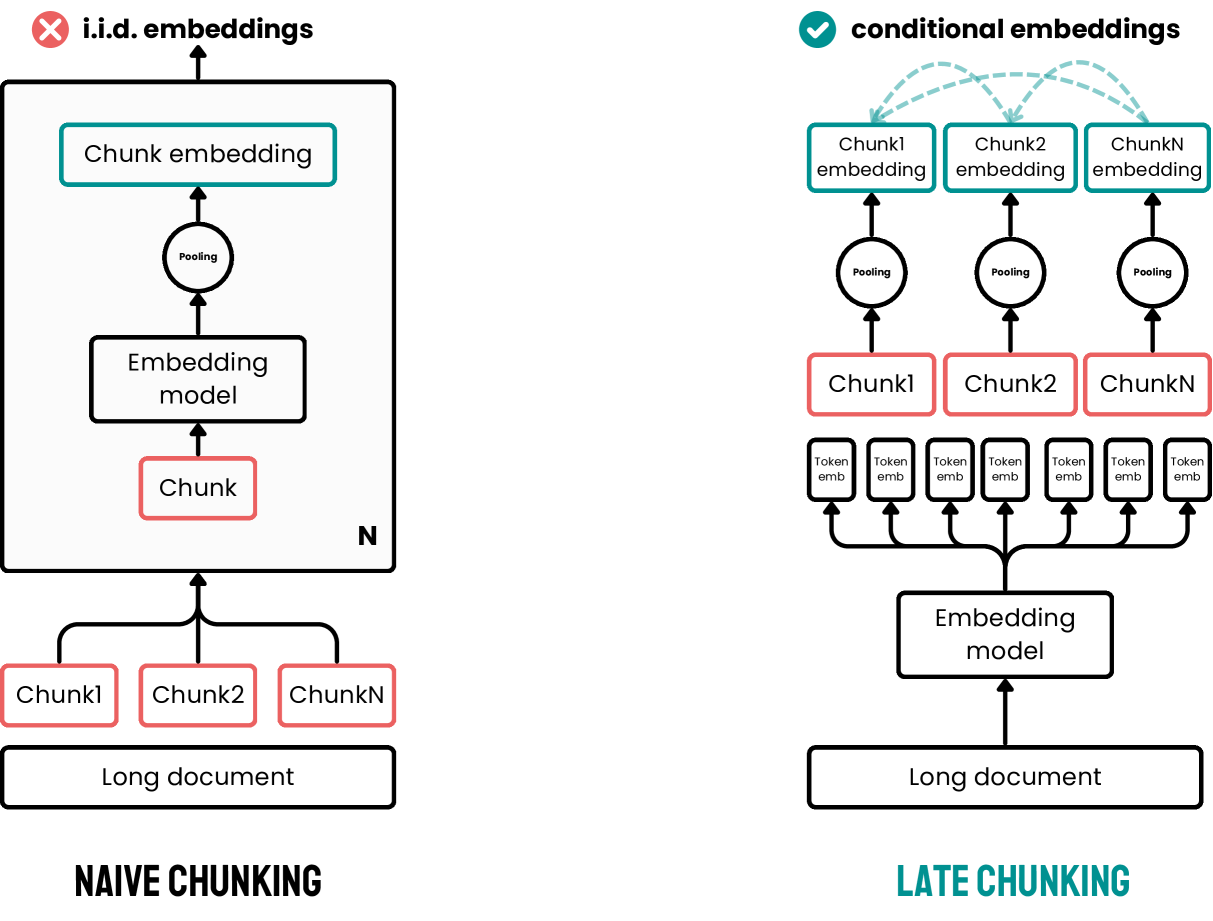
Late Chunking approach we propose in this article first applies the transformer layer of the embedding model to the entire text or as much of it as possible. This generates a sequence of vector representations for each token that encompasses textual information from the entire text. Subsequently, mean pooling is applied to each chunk of this sequence of token vectors, yielding embeddings for each chunk that consider the entire text’s context. Unlike the naive encoding approach, which generates independent and identically distributed (i.i.d.) chunk embeddings, late chunking creates a set of chunk embeddings where each one is “conditioned on” the previous ones, thereby encoding more contextual information for each chunk.
# Related
- Visual Late Chunking ( Link) — extends late chunking to the visual domain (ColChunk, Yan et al. 2026)
# Comparison
| Naive Chunking | Late Chunking | |
|---|---|---|
| The need of boundary cues | Yes | Yes |
| The use of boundary cues | Directly in preprocessing | After getting the token-level embeddings from the transformer layer |
| The resulting chunk embeddings | i.i.d. | Conditional |
| Contextual information of nearby chunks | Lost. Some heuristics (like overlap sampling) to alleviate this | Well-preserved by long-context embedding models |