Memory Control for Long-Horizon Agents
Properties
tags
gen_aigen_ai/agents
created
15.02.2026, 12:10
modified
15.02.2026, 12:12
published
Empty
topics
Empty
authors
Empty
ai-assisted
No
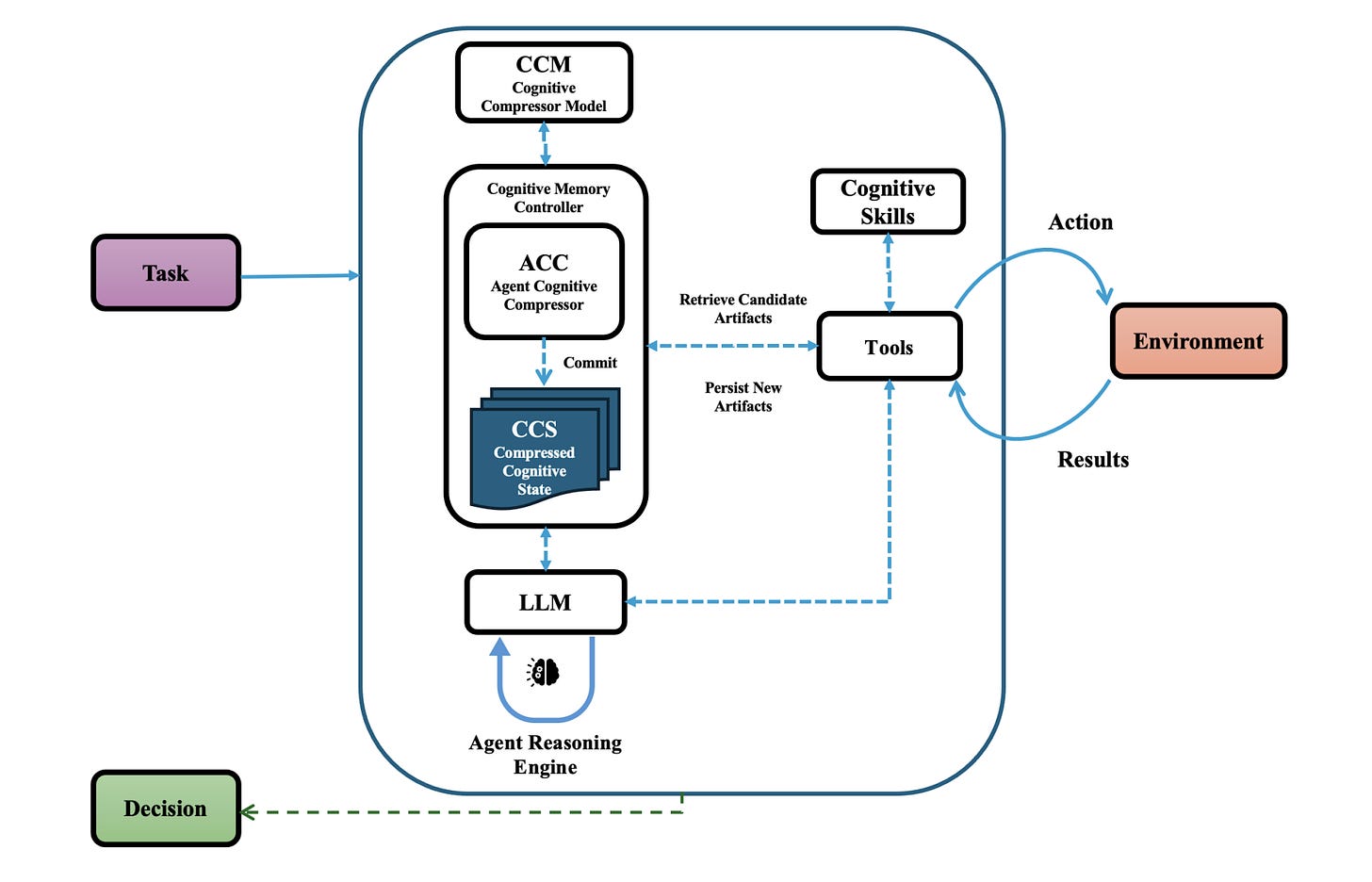
This paper introduces the Agent Cognitive Compressor (ACC), a bio-inspired mechanism that addresses degraded agent behavior in long multi-turn workflows caused by loss of constraint focus, error accumulation, and memory-induced drift. ACC replaces continuous transcript retention with a bounded internal state that updates incrementally during each interaction turn.
- The problem with unbounded context: Traditional approaches using transcript replay or retrieval-based memory systems create unbounded context growth and introduce vulnerabilities to corrupted information, causing agent performance to degrade over extended interactions.
- Bio-inspired bounded memory: Drawing from biological memory systems, ACC maintains a bounded internal state rather than continuously growing context, enabling stable performance without the computational costs of ever-expanding transcripts.
- Agent-judge evaluation framework: The authors developed an agent-judge-driven evaluation framework to assess both task success and memory-related anomalies across extended workflows in IT operations, cybersecurity response, and healthcare contexts.
- Reduced cognitive drift: ACC demonstrated substantially improved stability in multi-turn interactions, showing significantly reduced hallucination and cognitive drift compared to traditional transcript replay and retrieval-based systems.
- Practical foundation: The research suggests that implementing cognitive compression principles provides a practical foundation for developing reliable long-horizon AI agent systems that maintain consistent behavior over extended deployments.