Residual Blocks
Properties
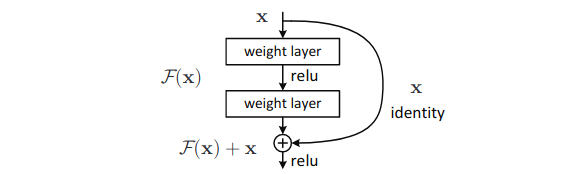
# 1. Gradient Through the Addition (Skip Connection):
In the residual block, after computing the output of the transformation \(\mathcal{F}(x)\) (through weight layers and activation functions), the output is added element-wise to the input \(x\) via the skip connection. This addition is crucial and impacts backpropagation.
Given that \(y = g(x + \mathcal{F}(x))\), where \(g(\cdot)\) is the activation function applied after the addition:
The gradient of the loss w.r.t. \(y\) is passed through \(g(\cdot)\), and then this gradient splits at the addition point into two paths:
$$ \frac{\partial L}{\partial (x + \mathcal{F}(x))} = \frac{\partial L}{\partial y} \odot g'(x + \mathcal{F}(x)) $$
Here, \(g'(\cdot)\) is the derivative of the activation function \(g(\cdot)\).Since \(y = x + \mathcal{F}(x)\), we distribute the gradient evenly between \(x\) and \(\mathcal{F}(x)\) due to the element-wise nature of the addition operation:
$$ \frac{\partial L}{\partial x} = \frac{\partial L}{\partial (x + \mathcal{F}(x))} $$
$$ \frac{\partial L}{\partial \mathcal{F}(x)} = \frac{\partial L}{\partial (x + \mathcal{F}(x))} $$
# 2. Combining the Gradients for \(x\):
Once we’ve backpropagated through the transformation \(\mathcal{F}(x)\) (the weight layers, activation functions, etc.), we get another gradient w.r.t. \(x\), which we denote as \(\frac{\partial L}{\partial x_{\mathcal{F}}}\). This gradient represents the contribution of the path through the transformation.
Since the skip connection directly connects \(x\) to the output, the total gradient w.r.t. \(x\) is the sum of the gradients from the two paths:
- The gradient coming from the identity path: \(\frac{\partial L}{\partial x}\).
- The gradient coming from the transformed path \(\mathcal{F}(x)\): \(\frac{\partial L}{\partial x_{\mathcal{F}}}\).
Thus, the total gradient w.r.t. \(x\) is:
# Summary of Additional Steps in a Residual Block:
- Gradient through the addition: The gradient splits at the addition point, with one path going through the skip connection and the other through the transformation \(\mathcal{F}(x)\).
- Combining gradients: After backpropagating through \(\mathcal{F}(x)\), sum the two gradients from the skip path and the transformation path to compute the total gradient with respect to \(x\).
These are the additional steps unique to residual blocks that differentiate them from standard backpropagation in a fully connected network. The skip connection allows gradients to flow more easily and helps prevent issues like vanishing gradients, particularly in deep networks.
# Extension
- Attention Residuals — replaces the fixed uniform skip connection with learned, input-dependent softmax attention over all prior layer outputs